H1 2026 Investment Review: Why We Believe Physical Infrastructure is Key to Climate Tech
In our view, the defining characteristic of the global climate tech market in the first half of 2026 was not simply funding volume, but a noticeable shift in how capital was deployed.
We believe the broader market is becoming increasingly disciplined, selective, and focused on tangible scale. As one of the UK's most active climate technology funds, OnePlanet Capital seeks to invest in businesses that are actively working to tackle major environmental challenges. Our founders created this firm with the thesis that significant value can be captured through the transition to a green economy via EIS and SEIS funds, leveraging their entrepreneurial experience to identify promising innovators.
OnePlanet Capital experienced an active first half of the year. We deployed capital into 19 unique climate technology companies, executing an investment strategy that prioritises physical infrastructure and hardware investments.
Here is a closer look at our H1 deployment data across sectors and business models, and the thesis behind our allocations.
1. Sector Breakdown: Addressing What We View as Primary Roadblocks
Our strategy is built on the belief that capital is often most effective when targeted at fundamental infrastructure categories where we consider carbon reduction to be most urgently needed.
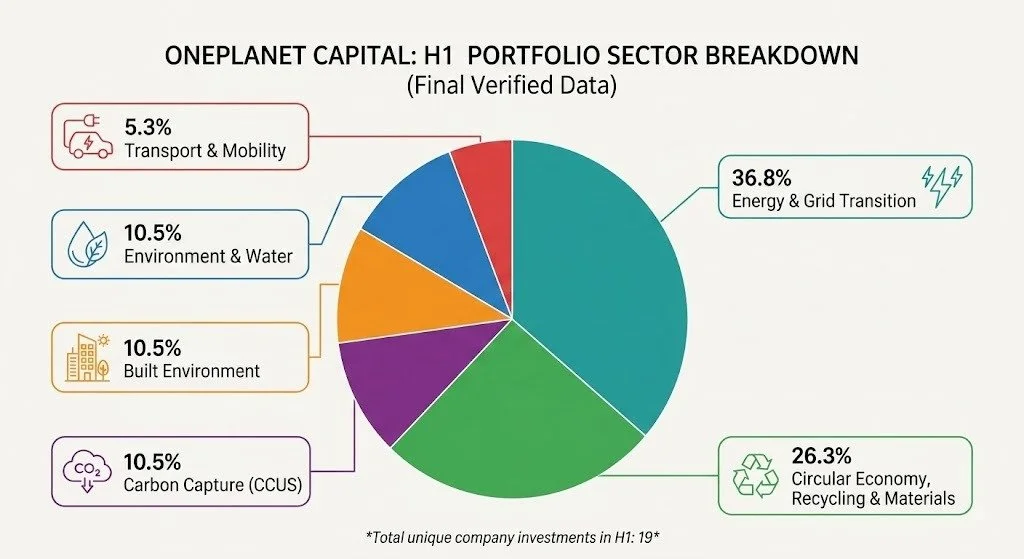
Our deployment across sectors broke down as follows:
Energy & Grid Transition: 36.8%
Circular Economy, Recycling & Materials: 26.3%
Carbon Capture (CCUS): 10.5%
Built Environment: 10.5%
Environment & Water: 10.5%
Transport & Mobility: 5.3%
Our View on the Energy & Grid Transition sector
Our core thesis is grid infrastructure, rather than renewable energy generation alone. Has become a primary bottleneck constraining the speed of the global energy transition. In our view, transmission infrastructure and system flexibility have struggled to keep pace with renewable deployment and rising electricity demand. Consequently, our largest H1 allocation (36.8%) toward the energy and grid transition, with the goal of supporting technologies that provide necessary grid flexibility.
2. Business Model Breakdown: Our Conviction in Physical Hardtech
Beyond sector categories, we believe how these solutions are delivered is equally critical. While early climate tech investing leaned heavily toward software and carbon accounting, our thesis is that decarbonizing heavy industry ultimately requires real-world, physical solutions.
In line with this belief, 63.2% of our H1 deployments directly funded physical hardtech, advanced manufacturing, and novel materials, complemented by a 36.8% allocation to high-margin digital software platforms.
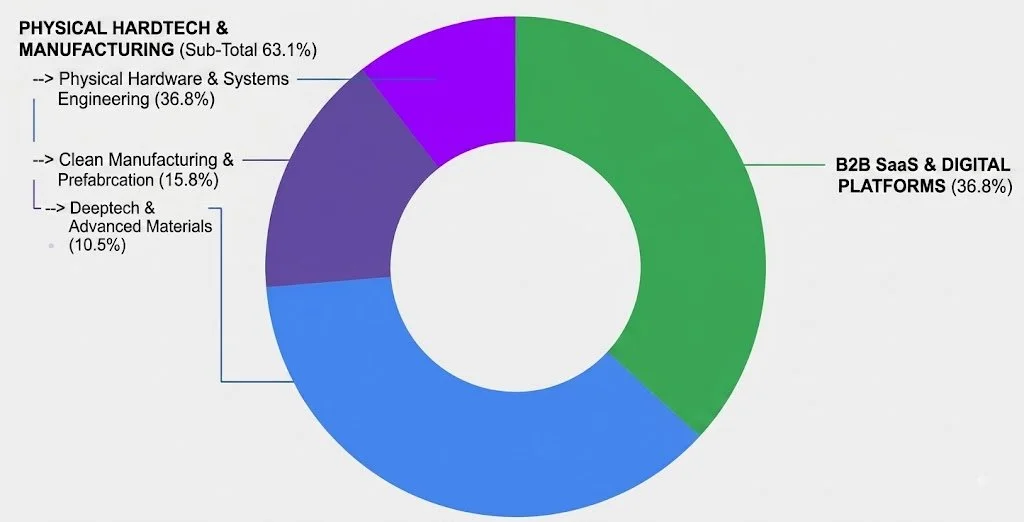
Our portfolio deployment strategy breaks down into four defined pillars:
Physical Hardware & Systems Engineering (36.8%): Backing engineered physical units, robotics, and electrochemical systems. Companies in this cohort include Hychor, which is developing systems aiming to produce green hydrogen directly from seawater, and Perceptual Robotics, utilizing AI-driven drone robotics for asset inspection.
B2B SaaS & Digital Platforms (36.8%): Investing in software platforms and digital twins designed to orchestrate grid and circular systems. Examples include Float Energy (digital twin software for hydrogen optimization) and Snugg (a platform aimed at simplifying home energy efficiency retrofits).
Clean Manufacturing & Prefabrication (15.8%): Supporting sustainable industrial production processes and low-carbon built environment components (e.g., Lineat, Vundahaus, Laundre).
Deeptech & Advanced Materials (10.6%): Backing green chemistry and material science aimed at replacing legacy high-carbon inputs (e.g., Forge Minerals, Demeter Bio).
Looking Ahead to Autumn
By seeking to combine scalable software with physical systems engineering, our portfolio strategy aims to support solutions to key commercial and environmental roadblocks.
As we prepare for our Autumn EIS and SEIS funds, our investment team is actively speaking with founders and undertaking due diligence across thesis areas we believe hold significant potential, such as energy bottlenecks, green hydrogen, and next-gen sustainable materials.
Click here to register early access for our upcoming Autumn EIS and SEIS funds
For more information please contact the OPC team at info@oneplanet.capital